
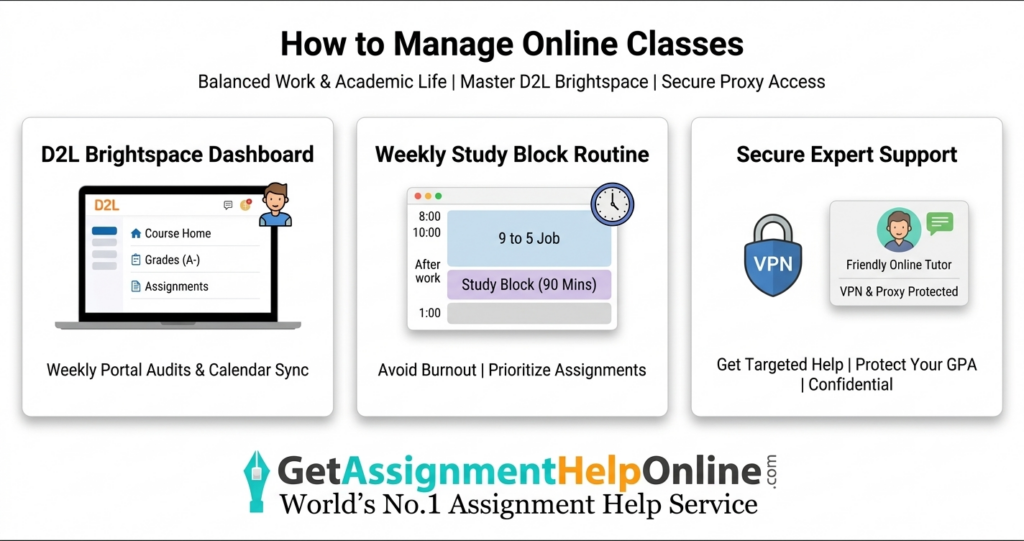
Learning how to manage online classes while maintaining a 40-hour workweek is one of the most demanding challenges an adult learner or college student can face. Whether you are enrolled in a technical diploma program at Algonquin College, completing business credentials at Niagara College, or upgrading skills through online modules across North America, the pressure to maintain a high GPA while performing at your job can quickly lead to exhaustion, missed deadlines, and academic burnout.
When you are balancing workplace responsibilities, family obligations, and a full academic load, traditional study advice like “just study harder” or “wake up an hour earlier” falls short. What you need is an actionable, systematic approach to task management, digital platform organization, and strategic workload delegation.
This comprehensive guide outlines a step-by-step framework to master your online learning management system (LMS), optimize your working hours, protect your mental health, and keep your career and academic progression on track.
1. The Anatomy of Working-Student Burnout (And How to Avoid It)
Before implementing time-management tactics, it is crucial to understand why so many working students struggle when trying to manage online classes. Unlike traditional on-campus classes that provide physical structure through set lecture times and classroom attendance, online courses demand complete self-regulation.
The Asynchronous Trap
The flexibility of asynchronous learning—where lectures, quizzes, and discussion boards are available 24/7—is a double-edged sword. It creates the illusion that you have “plenty of time” to complete tasks. Consequently, students often push coursework to late Sunday evenings, leading to rushed submissions, lost points on weekly quizzes, and extreme anxiety.
Cognitive Overload and Context Switching
Switching your brain directly from workplace problem-solving (such as managing clients, writing code, or running operations) to academic analysis (such as drafting sociology essays or tackling advanced technical math problems) creates heavy cognitive fatigue. Without deliberate buffer zones between your job and your coursework, your productivity in both areas plummets.
2. How to Manage Online Classes on D2L Brightspace, Canvas, and Blackboard
Your Learning Management System (LMS) is the central command center for your academic success. Having structured portal routines gives you the tools you need to manage online classes effectively without feeling overwhelmed.
The Monday Morning Portal Audit
- Clear Notifications: Check instructor announcements and internal portal messages daily.
- Sync Due Dates: Map all upcoming quizzes, labs, and assignments to your calendar every Monday.
- Download Assets: Save lecture slides, assignment rubrics, and PDFs locally for offline review.
- Flag Discussions: Note early discussion board initial posting deadlines (often Thursday mid-week).
Perform a Semester Syllabus Audit
On the first day of the term, do not simply skim through course outlines. Open every single course portal—whether hosted on D2L Brightspace, Canvas, Moodle, or Blackboard—and execute a complete syllabus audit:
- Extract Every Single Grading Event: Transfer all exam dates, timed quiz windows, lab submissions, and discussion board initial posting deadlines directly into a centralized digital calendar like Google Calendar or Outlook.
- Identify Weight-Heavy Modules: Note which assignments account for the largest percentage of your grade. A weekly quiz worth 1% should never take precedence over a capstone project worth 25%.
- Track Submission Deadlines: Be mindful of time zones and exact cut-off times. Many Canadian college portals default submission cut-offs to 11:59 PM EST on Sundays; missing this window by two minutes can result in an automatic zero or heavy late penalties.
Master the “Discussion Board First” Rule
In many online college programs, instructor discussion prompts require an initial post by Thursday evening and two peer replies by Sunday evening. Drafting your initial discussion posts on Monday or Tuesday evening while reading the assigned weekly chapter secures free participation points early and prevents mid-week stress.
3. Time-Blocking Strategies to Manage Online Classes
Generalized time management does not work when your daytime hours are locked in by an employer. To successfully manage online classes alongside a career, you must build a rigid, non-negotiable schedule that treats study windows with the same seriousness as a workplace client meeting.
The Time-Chunking Framework
| Time Window | Activity Focus | Ideal Coursework Tasks |
|---|---|---|
| Morning Buffer (30–45 Mins) | High Focus / Fresh Brain | Reading dense textbook chapters, watching recorded lectures, drafting outlines |
| Lunch Break Micro-Window (20 Mins) | Low Cognitive Load | Reviewing flashcards, answering multiple-choice quiz prep, checking portal announcements |
| Evening Post-Work (60–90 Mins) | Execution / Output | Writing essay sections, completing coding labs, submitting discussion replies |
| Weekend Dedicated Block (2–3 Hours) | Deep Focus Work | Completing major midterms, working on capstone projects, preparing complex assignments |
The Power of 90-Minute Focus Blocks
Research in cognitive performance—such as attention studies from the American Psychological Association (APA)—shows that the human brain can only maintain peak focus for roughly 90 minutes before diminishing returns set in. Never schedule vague 5-hour weekend study sessions. Instead, block out two distinct 90-minute sessions separated by a mandatory 30-minute break away from screens. Use strict distraction blockers to restrict social media and work emails during these windows.
4. Subject-Specific Survival Strategies
Different subjects demand distinct approaches when you are short on time. Here is how to handle the most demanding course types:
STEM, Math, and Computer Science Courses
Technical courses require active practice rather than passive reading:
- Do Not Read the Textbook Cover-to-Cover: Go directly to the practice problems at the end of the module. Work backward from problem sets to theory to save time.
- Isolate Syntax and Logic Early: For programming assignments, outline your algorithm logic on paper or in pseudo-code during micro-breaks throughout the week so you aren’t staring at a blank screen on Sunday night.
Humanities, Business, and Social Sciences
Courses in business law, marketing, or organizational behavior carry high reading loads and lengthy essay requirements:
- Read Strategy Over Speed: Focus heavily on introduction paragraphs, chapter summaries, section headings, and conclusion sections.
- Use the Reverse Outline Method: Before writing a major term paper, write out the topic sentence of every paragraph first. Once the framework is built, filling in evidence and citations becomes significantly faster.
5. Strategic Delegation: Knowing When to Get Support
Even with flawless time management, life throws unexpected obstacles in your path. Mandatory overtime at work, family emergencies, illness, or an overwhelming pile-up of overlapping deadlines across four different courses can push anyone to the brink.
Recognizing when your academic standing is in danger—and taking proactive measures—is a trait of successful students who know when to seek external support to manage online classes during critical weeks.
When to Seek Professional Online Course Assistance
- You are facing mandatory workplace overtime during midterm or exam week.
- Multiple major assignments and proctored quizzes fall on the exact same date.
- A prerequisite course like advanced math or coding threatens your GPA.
- You need reliable, secure portal management to keep your grade at an A or B.
Leveraging Academic Support Services
When your schedule is stretched past its breaking point, leaning on professional educational support can protect your GPA and prevent course failure. Whether you need expert assistance managing weekly portal tasks, completing complex research assignments, or ensuring you score top marks on critical online quizzes, partnering with experienced academic professionals keeps your progress moving forward seamlessly.
6. Maintaining Physical and Mental Resilience
Academic burnout is not just a mental state; it manifests physically through poor sleep, chronic stress, and decreased job performance. Maintaining health fundamentals is essential for long-term endurance.
Protect Your Sleep Architecture
Sacrificing sleep to complete late-night assignments is counterproductive. Sleep deprivation impairs memory consolidation, meaning information learned during late-night study sessions is rapidly forgotten. According to public health guidelines from the Centers for Disease Control and Prevention (CDC), adults require a consistent 7-hour sleep window to maintain cognitive function and academic focus.
Establish a Hard “Shutdown” Time
Define a firm time each evening (such as 9:30 PM) where all academic and work-related laptops and portal tabs are closed. Giving your brain a 60-minute wind-down buffer before bed dramatically lowers cortisol levels and improves overall sleep quality.
Summary Checklist for Working Students
- Audit Your LMS Weekly: Log into Brightspace or Canvas every Monday morning to review new announcements and sync upcoming due dates.
- Batch Small Tasks: Complete initial discussion posts and short module readings during early-week micro-windows.
- Protect Focus Blocks: Dedicate two to three 90-minute distraction-free study blocks on weekends for heavy project work.
- Work Backward on Problem Sets: For math and technical subjects, jump straight into practice problems to locate knowledge gaps quickly.
- Get Backup When Needed: Don’t let a temporary work crisis permanently damage your academic transcript—utilize expert online course help when deadlines overlap.
By transforming your approach from reactive cramming to systematic management, you can successfully earn your college credentials, excel in your career, and enjoy a balanced lifestyle.